The first image everyone saw was that of a little girl. Big eyes, curly hair tied back with small, colorful hair ties, a smile that seemed to know no fear. One of those smiles that deceive the world, because behind it was a story that no one wanted to see in time.
The second image showed an old, damp laundry room, stained by the passage of time. Piles of children’s clothes, a rusty faucet, green walls covered in mold. A common, everyday place, one of those invisible corners where the daily routine is repeated… and where tragedy can also lurk.
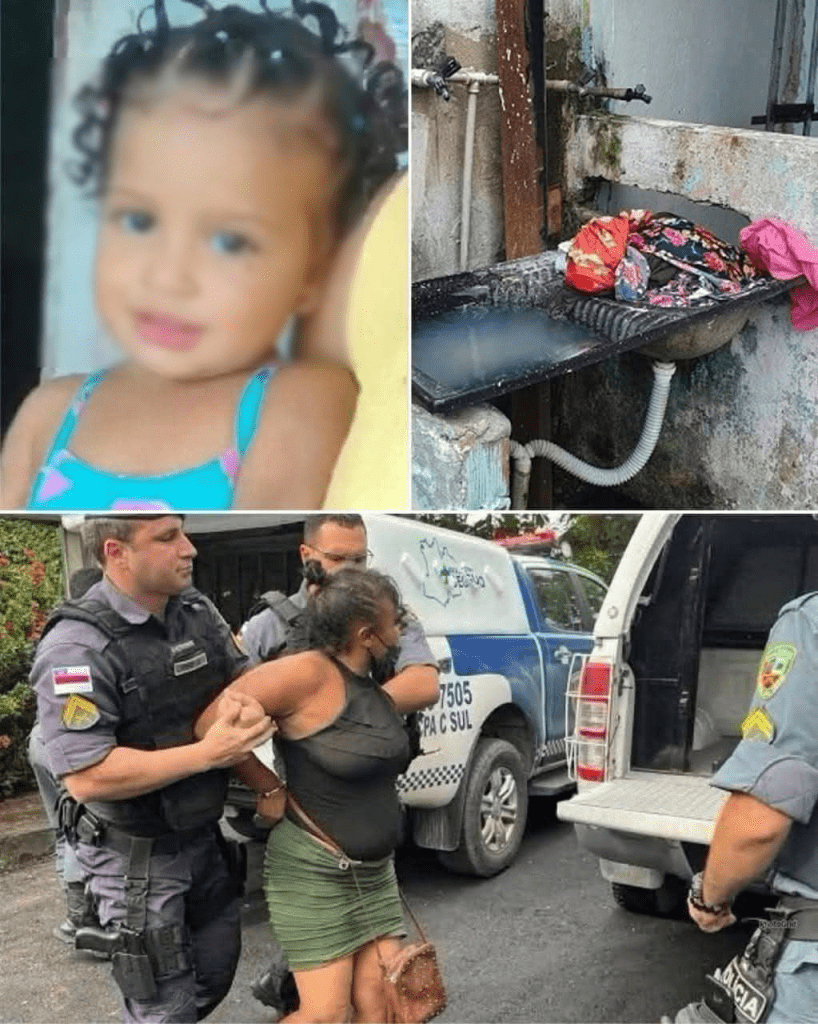
The third image was the most harrowing: a woman in handcuffs, being dragged by police officers toward a patrol car. Her face didn’t scream innocence or remorse, but something worse: emptiness. An emptiness that could no longer be filled with explanations.
Nobody imagined that those three images were linked by a single story.
The girl’s name was Camila. She was barely three years old. She liked to run barefoot around the house, play with a one-eyed doll, and hide behind the curtains to scare her mother. Every morning she woke up hungry and thirsty, asking for water, milk, anything to soothe her dry throat.
But that day… that day was different.
Her mother hadn’t slept well for weeks. Exhaustion had settled into her bones, mixed with frustration, poverty, and a rage she couldn’t pinpoint, but which grew like a shadow inside her. No one had taught her how to be a mother. No one had helped her when she silently screamed that she couldn’t take it anymore.
Camila cried that morning. She didn’t want to drink what her mother offered her. The taste was strange. Bitter. The little girl pushed the glass away with her tiny hands, spilling some of the liquid on the floor.
That was the exact moment something broke.
“Take it!” shouted the mother, in a voice that didn’t sound like her own.
Camila shook her head. She cried harder. She didn’t understand the anger, she only felt fear. She tried to run, but was caught. Her crying turned into pleading. A silent pleading.
Nobody listened.
The washbasin was a silent witness. Water continued to flow from the tap as time stood still. The children’s clothes remained there, as if waiting for someone to return for them.
When it was all over, the house fell into an unbearable silence. There was no crying. No footsteps. Only a false, heavy, cruel calm.
Hours later, the neighbors began to ask questions. No one had seen the girl playing. No one had heard her laugh. The feeling of something was wrong came before the truth.
The police entered. The place was small, but the horror seemed to have no walls. Camila’s fragile body no longer responded. Her eyes, which had once shone, were closed forever.
The mother didn’t scream when they handcuffed her. She didn’t fight back. She walked like someone who had already lost everything before even losing her freedom.
The news spread like wildfire.
“This mother killed her daughter for not wanting to drink…”
The comments were filled with hate, judgment, and rage. No one spoke of Camila as a child. She became a case. A headline. An image shared thousands of times.
But Camila wasn’t a mistake.
She wasn’t an accident.
She wasn’t just a news story.
She was a little girl who wanted to say “no.”
She was a little girl who trusted.
Her life depended entirely on the one who was supposed to protect her.
Today, her photo circulates on cold screens. The laundry room is still there, empty. The clothes no longer move. The one-eyed doll was forgotten in a corner.
And while the mother awaits her sentence, the world keeps turning, as if nothing has happened. But there is something that cannot be erased: the gaze of a little girl who never understood why loving hurt so much.
Because not all tragedies make noise.
Some happen in silence, with a running tap and a glass that was never touched.