“I came back for you.”
Part 1:
The Scrap Collector Boy and the Burger Promise
“Can I buy the cheapest burger?”
The question was so quiet that Marcus Reed almost didn’t hear it.
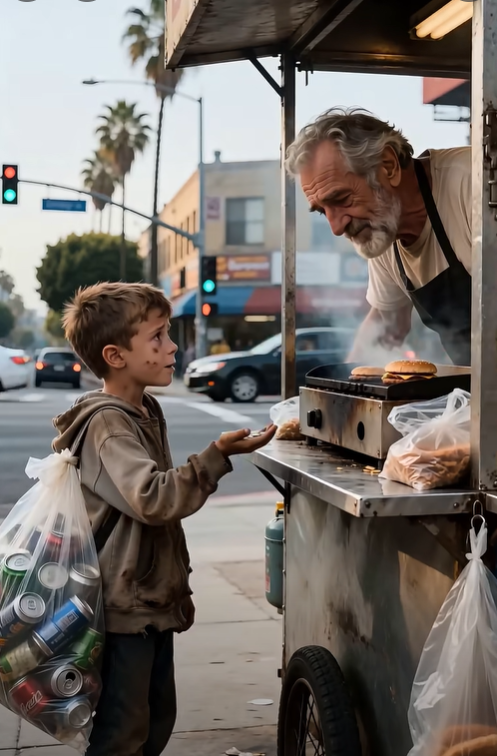
He was leaning over the grill on a bright spring morning in Los Angeles, sweat already collecting under the collar of his faded T-shirt as grease hissed beneath a row of burgers.
The city was fully awake.
Cars rolled past in steady lines.
Buses exhaled at the curb.
Office workers hurried by with coffee cups in hand, their eyes fixed on phones and schedules and everything waiting for them downtown.
No one paid attention to the old burger cart on the corner of Wilshire and Vermont.
And almost no one noticed the boy standing in front of it.
Marcus looked up.
The child couldn’t have been more than nine years old.
He was thin in the way that made Marcus’s chest tighten immediately.
Not naturally skinny.
Hungry skinny.
His brown hoodie hung off his shoulders like it belonged to someone else. Dirt smudged his cheeks. His sneakers were torn, and the laces had been replaced by mismatched pieces of string.
Over one shoulder he carried a giant plastic bag stuffed with crushed soda cans.
The bag looked almost bigger than he was.
The boy slowly opened his hand.
A few coins lay in his palm.
Nickels.
Pennies.
A single quarter.
The metal trembled as he held them out.
“Can I buy the cheapest burger?” he asked again.
Marcus looked at the coins.
Then at the boy.
Then back at the coins.
Even the plain burger cost more than twice that amount.
He didn’t answer right away.
Not because he didn’t want to help.
Because he had spent the entire morning worrying about whether he could afford to help anyone.
Marcus was sixty-seven years old.
His hair had gone silver years ago.
Deep lines cut across his weathered face.
Arthritis stiffened his fingers every morning before sunrise.
And his small sidewalk cart—an old stainless-steel grill under a faded red umbrella—was the only thing standing between him and having nothing.
He had worked this same corner for nearly thirty years.
Some days were good.
Most weren’t.
The rent on his tiny apartment had gone up again.
The city permit fees had increased.
His doctor wanted him to rest more.
His body agreed.
His bank account did not.
That morning, tucked beside the register, sat a stack of overdue bills held together with a rubber band.
Electricity.
Medical expenses.
Rent.
Past due.
Past due.
Final notice.
Marcus had been staring at those bills all morning, trying to figure out which one he could ignore the longest.
Now a hungry child stood in front of him.
And the few dollars he had left were supposed to buy groceries for the week.
Marcus swallowed.
The practical part of him whispered the obvious answer.
Not today.
I’m sorry.
I can’t.
But then the boy shifted his weight.
And Marcus noticed the way his eyes stayed fixed on the burgers sizzling on the grill.
Not curious.
Not greedy.
Desperate.
Marcus knew that look.
He had seen it in the mirror decades ago.
He had grown up in foster homes and cheap apartments where dinner was never guaranteed.
He knew what real hunger looked like.
It didn’t complain.
It didn’t beg.
It simply waited.
Quietly.
Hoping.
Marcus exhaled.
Then he closed the boy’s fingers gently over the coins.
“Keep your money.”
The boy blinked.
Marcus turned back to the grill.
He laid a fresh patty onto the hot steel.
The sizzle was immediate.
He toasted a soft sesame bun.
Added melted cheese.
A few crisp fries.
Nothing fancy.
Just a burger made with care.
The kind of meal that said, without words:
You matter.
When he wrapped it and handed it over, the boy hesitated.
“Really?”
Marcus smiled.
“Eat. You don’t owe me anything.”
For a moment, the boy simply stared at the warm paper bundle in his hands.
Steam curled into the cool morning air.
His throat bobbed.
His eyes filled with tears.
Not loud tears.
The quiet kind.
The kind that came when someone had been strong for too long.
He clutched the food with both hands.
“I’ll never forget this.”
Marcus felt something tighten in his chest.
He nodded once.
“What’s your name, kid?”
“Ethan.”
“Well, Ethan,” Marcus said, “you take care of yourself.”
The boy gave a solemn nod.
Then he stepped to the side of the cart and sat on the curb.
Marcus watched as Ethan unwrapped the burger.
The boy took one bite.
Then another.
His eyes closed briefly, as if he was trying to hold onto the feeling of being warm and full.
Marcus turned back to the grill, but he found himself glancing over every few seconds.
When Ethan finished, he carefully folded the wrapper and tucked it into his pocket.
As if it were something valuable.
He stood, adjusted the giant bag of cans on his shoulder, and looked back at Marcus.
“I mean it,” he said. “I’ll never forget this.”
Then he disappeared into the crowd.
Marcus stood there for a long moment after the boy was gone.
Then he returned to work.
Customers came and went.
Lunch hour arrived.
The city kept moving.
But the memory of Ethan stayed with him.
Days became months.
Months became years.
Marcus continued opening the cart before sunrise.
He worked through heat waves and rainstorms.
Through aching knees and stiff hands.
He learned to ignore the pain in his back and the loneliness that waited for him each night in his small apartment.
He never married.
Never had children.
Life had always been about surviving one week at a time.
Still, every now and then, he thought about the scrap collector boy.
He wondered if Ethan had found his parents.
If he had gone to school.
If he was safe.
If he was alive.
Sometimes another hungry child would appear at the cart.
And Marcus would remember those tear-filled eyes.
He always made an extra burger.
No charge.
People told him he was too generous.
“You can’t feed every kid in Los Angeles,” one regular said.
Marcus simply smiled.
“No,” he replied. “But I can feed the one standing in front of me.”
Twenty-five years passed.
The city changed.
Towering buildings rose around streets Marcus barely recognized.
The little burger cart grew older, just as he did.
The umbrella faded.
The paint chipped.
The metal register stuck unless you hit it twice.
Marcus’s shoulders bent forward more each year.
His hair thinned.
His hands shook when he counted change.
But he kept showing up.
Because the cart was more than his job.
It was his life.
And then came the hardest year of all.
Construction nearby reduced foot traffic.
Sales dropped.
Medical bills piled up after Marcus spent two nights in the hospital with chest pains.
He ignored his doctor’s warnings and returned to work two days later.
What choice did he have?
On a bright Tuesday morning, Marcus stood alone behind the cart.
Business was painfully slow.
He opened the register.
Inside were a few wrinkled bills and some coins.
Not enough.
He unfolded the overdue notices tucked beside the cash drawer.
His hands trembled.
Rent was due in three days.
His supplier had already called twice.
For the first time in thirty years, Marcus allowed himself to think the unthinkable.
This might be the end.
He lowered his head.
The morning traffic roared around him.
People hurried past.
No one noticed the old man fighting to keep the only thing he owned.
Then he heard it.
A sound that didn’t belong on this corner.
A low, smooth engine.
Marcus looked up.
A gleaming black luxury sedan moved slowly through traffic and pulled to the curb directly beside his cart.
Its paint reflected the sunlight like polished glass.
The car was so immaculate that it seemed almost unreal against the worn sidewalk and faded umbrella.
Pedestrians turned to stare.
Marcus frowned.
People like that didn’t stop at places like his.
The engine shut off.
For a moment, nothing happened.
Then the rear door opened.
A tall man stepped out.
Early thirties.
Tailored black suit.
Polished shoes.
Confident posture.
But there was something about his face.
Something familiar.
The man stood still for a moment, looking at the cart.
At the faded menu board.
At the rusted grill.
At Marcus.
His expression changed.
The polished composure cracked.
Emotion rose in his eyes.
Marcus felt a strange tightening in his chest.
The man began walking toward him.
Slowly.
Deliberately.
As if each step carried the weight of years.
Marcus straightened as much as his aching back allowed.
“Can I help you?” he asked.
The man stopped in front of the cart.
For a second, he didn’t speak.
Instead, he looked down at Marcus’s weathered hands.
At the overdue bills beside the register.
At the same worn grill where a hungry boy had once been given a meal he could not afford.
Then the man smiled.
And Marcus’s breath caught.
Because suddenly he saw it.
The eyes.
The same eyes that had looked up at him twenty-five years earlier, shining with tears above a paper-wrapped burger.
The man reached into the car and withdrew a thick leather folder.
He placed it gently on the counter.
Marcus stared at him, his heart pounding.
The man’s voice was soft.
Steady.
Filled with gratitude.
“I came back for you.”
“I came back for you.”
Marcus stared at him.
For a moment, the street disappeared.
The traffic.
The pedestrians.
The morning heat rising from the grill.
All of it faded behind one impossible truth.
The boy had come back.
The hungry child with dirty cheeks and trembling coins now stood before him in a tailored black suit, eyes wet, voice steady, holding a folder that looked too expensive to belong beside a rusted register.
Marcus tried to speak.
Nothing came out.
His hand reached for the counter, fingers shaking so badly the overdue bills fluttered beneath them.
“You…” Marcus whispered. “You’re Ethan?”
The man nodded.
A small smile broke through the emotion on his face.
“Yes, sir.”
Marcus blinked hard.
“No.” His voice cracked. “No, that can’t be. You were just a little boy.”
Ethan let out a soft, breathless laugh.
“I know.”
Marcus’s eyes moved across his face, searching.
The jaw was different.
The posture was different.
The clothes, the watch, the car behind him—everything was different.
But the eyes were the same.
Those same eyes that had looked at a burger like it was a miracle.
Marcus covered his mouth.
The memory hit him so hard his knees almost gave out.
Ethan quickly stepped around the side of the cart.
“Mr. Reed—”
Marcus raised one hand.
“I’m alright,” he lied.
He wasn’t.
Not even close.
For twenty-five years, Marcus had carried that morning quietly.
He had never expected anything from it.
Not thanks.
Not money.
Not a return.
He had simply hoped the boy survived.
Now survival stood in front of him wearing a suit worth more than Marcus’s cart.
Ethan glanced at the overdue bills beside the register.
Marcus noticed.
Shame moved through him quickly.
He reached to gather them.
“No, don’t look at those.”
Ethan gently placed his hand over the papers before Marcus could hide them.
His touch was careful.
Respectful.
“Please,” Ethan said. “Don’t hide them from me.”
Marcus looked away.
“It’s nothing.”
“It doesn’t look like nothing.”
Marcus forced a dry laugh.
“You came all this way to buy breakfast, or to inspect an old man’s problems?”
Ethan’s smile faded.
“I came because of them.”
Marcus froze.
A strange unease passed through him.
“Because of what?”
Ethan looked toward the black sedan.
A woman stepped out of the passenger side.
She was in her late fifties, maybe early sixties, dressed simply in a navy blazer, holding a tablet against her chest.
Her expression was controlled, but her eyes were warm.
Behind the sedan, a second car pulled up.
Then another.
Three people climbed out—two men in suits and a young woman carrying a camera bag.
Marcus’s stomach tightened.
“What is this?” Marcus asked.
Ethan turned back to him.
“I need you to trust me for a few minutes.”
Marcus looked at the camera bag.
His face hardened.
“No.”
Ethan understood immediately.
He raised his hand toward the woman.
“No cameras.”
The young woman stopped at once.
Ethan didn’t raise his voice.
He didn’t need to.
Everyone obeyed.
Marcus noticed that too.
The boy who once stood hungry in front of his cart now moved like someone the world listened to.
That should have made Marcus proud.
Instead, it made him afraid.
“Ethan,” Marcus said quietly, “I don’t want a show.”
“It isn’t a show.”
“Then why are they here?”
Ethan hesitated.
For the first time since stepping out of the car, he looked nervous.
The powerful man disappeared.
The boy showed through.
“Because I didn’t come alone.”
Marcus frowned.
Before he could ask what that meant, the woman in the navy blazer approached.
She stopped a respectful distance from the cart.
“Mr. Reed,” she said softly. “My name is Grace Holloway. I’m Ethan’s legal counsel.”
Marcus gave Ethan a confused look.
“Legal counsel?”
Ethan opened the folder on the counter.
Inside were documents, photographs, and a small clear plastic sleeve.
Marcus’s eyes dropped to the sleeve.
His breath stopped.
Inside it was an old burger wrapper.
Yellowed.
Creased.
Preserved like evidence.
Marcus took half a step back.
Ethan touched the sleeve with two fingers.
“I kept it.”
Marcus stared.
“You kept… that?”
Ethan nodded.
“For years, I thought it was the only proof that someone had once been kind to me without wanting anything.”
The words landed heavily.
Marcus looked at the wrapper again.
There was a grease stain on one corner.
A faded red stamp from the old paper Marcus used decades ago.
REED’S BURGERS.
He hadn’t used that stamp in twenty years.
He thought all those wrappers were gone.
Ethan looked down at it.
“I used to unfold it when things got bad.”
Marcus’s eyes filled again.
“When things got bad?” he asked.
Ethan didn’t answer right away.
His jaw tightened.
The city moved around them, but the space between them became painfully still.
“I didn’t go home that day,” Ethan said.
Marcus’s face changed.
“What?”
Ethan swallowed.
“I didn’t have one.”
Marcus closed his eyes.
He had suspected.
Of course he had.
But hearing it now made something old and helpless open inside him.
Ethan continued, voice low.
“My mother had left two months earlier. My father was gone before I could remember him. I was sleeping behind a recycling center and collecting cans because I thought if I could get enough money, I could buy food every day.”
Marcus whispered, “Oh, kid…”
“I was tired,” Ethan said. “I was so tired that morning. I remember thinking if you said no, I would just sit down somewhere and not get back up.”
Marcus gripped the counter.
Ethan looked at him.
“That burger didn’t just feed me, Mr. Reed. It interrupted something I didn’t know how to survive.”
Marcus lowered his head.
For a long moment, he couldn’t speak.
The grill hissed behind him.
A patty burned slightly at the edge.
Marcus didn’t move to flip it.
Ethan did.
He stepped around the cart like he had done it a thousand times before, picked up the spatula, and gently turned the patty over.
Marcus watched him, stunned.
Ethan smiled faintly.
“I learned to cook later.”
Marcus let out a shaky breath.
“You shouldn’t touch that. You’ll ruin your fancy suit.”
“I’ve ruined worse.”
That made Marcus laugh through tears.
A real laugh.
Small, cracked, but alive.
Then Ethan set the spatula down and returned to the folder.
“I wasn’t the only one who remembered you.”
Marcus frowned.
“What do you mean?”
Grace Holloway opened her tablet and turned it toward Marcus.
On the screen was a photograph.
A woman.
Mid-thirties.
Standing outside a food pantry.
Then another image appeared.
A man in a mechanic’s uniform.
Then a nurse.
Then a teacher.
Then a father holding a little girl.
Marcus stared at the faces.
Some were familiar.
Not fully.
But enough to disturb him.
“I don’t understand,” he said.
Grace spoke gently.
“Over the years, Mr. Reed, you gave free meals to many children, homeless workers, runaway teens, single parents, veterans, and people who were too ashamed to ask directly.”
Marcus shifted uncomfortably.
“I gave a few burgers. That’s all.”
Ethan looked at him with quiet intensity.
“No. You gave people one moment where the world didn’t turn away.”
Marcus shook his head.
“You’re making it sound bigger than it was.”
“It was bigger than you knew.”
Grace tapped the tablet.
A video appeared.
A woman sat in an interview chair.
Her eyes were bright.
“I was sixteen when Marcus fed me,” she said on the screen. “I had run away from an abusive stepfather. I hadn’t eaten in two days. He didn’t ask questions. He just gave me food and said, ‘You’re safe standing here.’ I became a social worker because of that sentence.”
Marcus stared at the screen.
His mouth opened slightly.
“I said that?”
Ethan nodded.
“You did.”
The video changed.
A man in a mechanic’s shirt appeared.
“I was sleeping in my car,” the man said. “Marcus gave me breakfast for a week. Wouldn’t take a dime. When I tried to pay him later, he told me, ‘Help someone else.’ So I did.”
Marcus turned away.
“No,” he whispered. “No, I don’t need to hear all that.”
Ethan closed the tablet gently.
“Why?”
Marcus’s voice broke.
“Because I didn’t do enough.”
The answer came out before he could stop it.
The silence after it was heavy.
Ethan stared at him.
Marcus kept his eyes on the grill.
“I saw too many people,” Marcus said. “Too many kids. Too many hungry faces. Sometimes I helped. Sometimes I couldn’t. Sometimes I pretended not to see because I was scared I’d lose everything too.”
His hands trembled harder.
“I’m not some saint, Ethan.”
Ethan’s expression softened.
“I know.”
Marcus looked at him sharply.
Ethan stepped closer.
“That’s why it mattered.”
Marcus swallowed.
Ethan continued.
“You were scared. Broke. Tired. Alone. And you still helped me.”
Marcus couldn’t answer.
A bus passed loudly, shaking the street for a second.
When the sound faded, Ethan opened the contract folder again.
“There’s something else.”
Marcus stiffened.
He didn’t like the tone.
“What else?”
Ethan looked at Grace.
Grace gave a small nod.
Ethan pulled out a document and laid it flat on the counter.
Marcus saw the city seal at the top.
His blood turned cold.
The permit office.
“Is this about my license?” he asked.
Ethan didn’t answer quickly enough.
Marcus’s fear sharpened.
“I knew it,” he said. “I knew they sent someone. Is that what this is? You bought a suit and came here to tell me the city finally wants me gone?”
“No.”
Marcus pointed at the paper.
“Then why do you have that?”
Ethan inhaled slowly.
“Because someone filed a complaint against your cart.”
Marcus stared.
“What?”
Grace spoke carefully.
“Several complaints, actually. Noise. Smoke. Blocking sidewalk access. Unsanitary conditions.”
Marcus looked wounded.
“That’s not true.”
“I know,” Ethan said.
Marcus’s face tightened.
“Who?”
Ethan hesitated again.
Across the street, a man stood near a coffee shop window.
He wore a tan jacket and sunglasses.
Marcus noticed him for the first time.
The man wasn’t looking at coffee.
He was looking at the cart.
Ethan followed Marcus’s gaze.
His expression changed.
Grace’s did too.
Marcus whispered, “Who is that?”
Ethan turned back.
“His name is Calvin Pierce.”
Marcus frowned.
“Never heard of him.”
“You’ve heard of his company.”
Ethan opened another page from the folder.
A glossy development rendering appeared.
Marcus saw glass towers.
Luxury shops.
A wide clean sidewalk.
A courtyard.
And right where his burger cart stood—
Nothing.
His throat tightened.
“What is this?”
Grace answered.
“Pierce Development recently purchased several properties on this block. Their plan requires clearing sidewalk vendors from the corner.”
Marcus stared at the shiny drawing.
His old cart had been erased from the future.
“They can’t just do that,” he said, but his voice already knew they could.
Ethan’s eyes remained fixed on him.
“They tried quietly first.”
Marcus remembered then.
The notices.
The inspections.
The sudden permit questions.
The supplier who stopped delivering on credit after “someone” called about unpaid risk.
The health inspector who came three times in one month.
The strange man who offered to buy the cart for almost nothing.
Marcus had thought it was bad luck.
He had thought the city was simply becoming harder.
Now he realized someone had been pressing from every side until he broke.
His face went pale.
“They wanted me to quit.”
“Yes,” Ethan said.
Marcus looked toward Calvin Pierce across the street.
The man checked his watch.
Waiting.
Marcus felt foolish.
Small.
An old man standing behind a smoking cart, being pushed around by people who could remove him without ever touching him.
Ethan’s jaw tightened.
“But Calvin made a mistake.”
Marcus gave a humorless laugh.
“What mistake?”
“He assumed nobody important cared about you.”
Marcus looked at him.
Ethan didn’t smile.
The words were not arrogant.
They were personal.
Then Grace pulled out another document.
“This folder includes three things,” she said. “First, a signed agreement purchasing the outstanding debt attached to your cart and supplier accounts.”
Marcus blinked.
“What?”
“Second,” she continued, “a legal challenge to every complaint filed against your vendor permit. We have evidence several were fraudulent or coordinated.”
Marcus gripped the counter.
“Evidence?”
Ethan looked across the street again.
“Calvin’s assistant sent the same complaint template from three fake email accounts. One of them still used Pierce Development metadata.”
Marcus stared at him.
“You found all that?”
Grace smiled slightly.
“Mr. Cole is very thorough when something matters to him.”
Mr. Cole.
Marcus looked at Ethan again, suddenly aware of the name.
“Cole?” he asked.
Ethan’s eyes shifted.
Another secret.
Marcus heard it in the silence.
“I thought your last name was…”
“I never told you my last name,” Ethan said softly.
Marcus thought back.
He was right.
The boy had only said Ethan.
Ethan Cole.
The name stirred something in Marcus’s memory.
He had seen it on business magazines.
Food distribution.
Restaurants.
Grocery chains.
School meal programs.
The Cole Foundation.
Marcus’s eyes widened.
“You’re that Ethan Cole?”
Ethan looked almost embarrassed.
“I am.”
Marcus let out a breath.
“My God.”
Ethan touched the folder again.
“Third,” he said, “is the part I need you to read carefully.”
Marcus looked down.
The first page had a title in clean black letters.
THE MARCUS REED COMMUNITY FOOD TRUST.
Marcus stopped breathing.
He read the words again.
His name.
His full name.
On a legal document.
“What is this?” he whispered.
Ethan’s voice softened.
“It’s a foundation.”
Marcus shook his head.
“No.”
“Yes.”
“No, Ethan.”
Ethan leaned closer.
“You don’t even know what it is yet.”
“I don’t need a foundation.”
“It isn’t just for you.”
Marcus froze.
Ethan opened the next page.
There were plans.
Not glossy towers.
Not luxury shops.
Food carts.
Small kitchens.
Mobile breakfast stations.
Vouchers.
Youth employment programs.
A map of Los Angeles neighborhoods marked in blue.
Marcus looked at every page, not fully understanding and somehow understanding all at once.
Ethan said, “I own a food logistics company. Restaurants, distribution centers, school meal contracts. For years, we’ve been building a program to get hot food to kids who fall through every crack in the system.”
Marcus’s eyes moved across the map.
“You named it after me?”
Ethan nodded.
“I tried to build it under another name. It never felt right.”
Marcus whispered, “Why?”
Ethan’s eyes filled again.
“Because the whole idea started here.”
He tapped the metal counter.
“This cart was the first place I learned food could be more than food.”
Marcus looked away.
The emotion was too much.
Ethan continued.
“But there’s another reason I came today.”
Marcus looked back.
Ethan’s face grew serious.
“Calvin Pierce doesn’t just want this corner. He wants city approval for a development that would remove twenty-three sidewalk vendors within six blocks. Most of them are older. Immigrants. People with no lawyers. People like you.”
Marcus’s chest tightened.
Ethan looked at the passing street.
“If I only save your cart, I’m doing what powerful people always do—helping one person while letting the machine keep working.”
Marcus listened silently.
“So the foundation will purchase a permanent vendor space in the new development zone,” Ethan said. “Not just for you. For every vendor being displaced.”
Grace added, “We’ve already negotiated with the city. Pierce Development is under review. If Mr. Pierce wants approval, he has to accept a community vendor protection agreement.”
Marcus looked across the street.
Calvin Pierce was now speaking angrily into his phone.
Marcus almost laughed.
The man looked smaller suddenly.
Not harmless.
But smaller.
Ethan turned back to Marcus.
“There’s one condition.”
Marcus stiffened.
“There’s always one.”
Ethan smiled gently.
“This one is yours to refuse.”
Marcus waited.
Ethan took a breath.
“I want you to be the first chair of the trust.”
Marcus stared at him.
“No.”
Ethan almost laughed.
“You said that fast.”
“Because that’s crazy.”
“It’s not.”
“I sell burgers on a sidewalk.”
“Exactly.”
Marcus pointed a trembling finger at the documents.
“You need someone educated. Someone who knows business.”
“I have those people.”
“Then why me?”
Ethan’s answer came immediately.
“Because they understand systems. You understand hunger.”
Marcus went still.
The words struck somewhere deep.
Ethan stepped closer.
“I can fund kitchens. I can hire managers. I can buy trucks. But I don’t know how to look at a child holding coins and know the difference between a tantrum and real hunger.”
Marcus’s face tightened.
“You learned.”
“I learned from you.”
Marcus lowered his gaze.
For a moment, all he could see was the little boy again.
The trembling coins.
The thin hoodie.
The way he had said, “I’ll never forget this.”
Marcus whispered, “I’m old, Ethan.”
“I know.”
“I’m tired.”
“I know.”
“I don’t even know if I can keep standing here another year.”
Ethan’s voice softened.
“Then don’t stand alone.”
Marcus looked up.
There it was.
The true offer.
Not charity.
Not rescue as performance.
Partnership.
Dignity.
Ethan was not buying the old man’s story.
He was asking him to help shape what came next.
Marcus’s throat burned.
Before he could respond, a sharp voice cut through the morning.
“Mr. Cole.”
Calvin Pierce had crossed the street.
He moved with the smooth confidence of a man used to being obeyed, but his jaw was tight.
Two assistants trailed behind him.
He ignored Marcus completely.
His eyes stayed on Ethan.
“This is a private development matter,” Calvin said.
Ethan turned slowly.
“So was the fraudulent complaint campaign?”
Calvin’s expression flickered.
Only for a second.
But Marcus saw it.
Grace saw it too.
Calvin recovered quickly.
“I don’t know what you think you have—”
Grace raised the tablet.
“We have timestamps, email headers, internal routing, and two former contractors willing to testify.”
Calvin’s face hardened.
Marcus gripped the counter, stunned by how calmly she said it.
Ethan looked at Calvin.
“You could have approached these vendors honestly.”
Calvin smiled thinly.
“Progress is never comfortable.”
Marcus felt the old shame rise again.
Progress.
That was what people called it when they erased lives with better lighting.
Calvin finally glanced at Marcus.
His eyes moved over the faded apron, the wrinkled face, the trembling hands.
Dismissal passed through them.
“Mr. Reed has had decades here. No one is entitled to occupy public space forever.”
Marcus flinched.
Ethan noticed.
His voice turned colder.
“You’re right.”
Calvin looked surprised.
Ethan continued, “No one is entitled to public space forever. But no corporation is entitled to steal it through intimidation and forged complaints.”
People on the sidewalk had begun to slow.
A few recognized Ethan.
Phones came out.
Ethan raised his hand.
“No recording, please.”
To Marcus’s surprise, most people lowered their phones.
Calvin’s smile thinned.
“You’re making a mistake.”
Ethan stepped closer.
“No. I made my mistake twenty-five years ago.”
Marcus looked at him, confused.
Ethan’s eyes remained on Calvin.
“I survived because one man helped me. Then I spent years telling myself success meant escaping places like this.”
His voice deepened.
“I built towers of food and money and systems. But I didn’t come back until this corner was almost gone.”
He glanced at Marcus.
“That was my mistake.”
Marcus shook his head faintly, but Ethan continued.
“Today I’m correcting it.”
Calvin’s face darkened.
“You don’t have the votes.”
Grace smiled.
“We do.”
Calvin’s eyes snapped to her.
She turned the tablet again.
On it was a live city council agenda.
Marcus couldn’t follow the details, but he saw Ethan’s company name, Pierce Development, vendor protection agreement, emergency review.
Grace said, “The hearing begins in forty minutes. Mr. Cole will testify. So will Mr. Reed, if he chooses.”
Marcus went cold.
“Me?”
Ethan turned to him.
“You don’t have to.”
Calvin laughed softly.
It was cruel.
“He won’t. Men like him don’t sit in hearings. They get confused. They get emotional. They forget details.”
Marcus’s face burned.
Ethan’s expression changed.
A quiet fury entered his eyes.
But before he could speak, Marcus did.
“I remember details.”
Everyone turned.
Marcus’s voice was low, but steady enough.
Calvin looked annoyed.
Marcus placed one trembling hand on the stack of overdue bills.
“I remember every inspection that came after I refused to sell.”
Calvin’s jaw tightened.
“I remember the man you sent who told me old carts were bad for the neighborhood.”
Marcus looked him directly in the eye.
“I remember he offered me less than the cost of my grill.”
Ethan watched Marcus carefully.
Marcus’s shoulders straightened slightly.
Not much.
But enough.
“I remember the fake complaints,” Marcus continued. “Because one said smoke from my cart bothered residents in a building that’s been empty since February.”
Grace’s eyes sharpened.
“You still have that complaint?”
Marcus reached under the register.
His hands moved slowly, but with purpose.
He pulled out a worn envelope.
“I keep everything.”
Ethan stared at the envelope.
Marcus glanced at him.
“When you’re poor, paperwork can be the only weapon they don’t expect you to have.”
Grace took the envelope carefully.
Calvin’s face lost color.
That was the second hidden truth: Marcus had not been helpless. He had been quietly documenting every attempt to erase him.
Ethan smiled through the tension.
“You never told anyone?”
Marcus shrugged.
“Who was I supposed to tell?”
Ethan’s smile faded.
The answer hurt because it was honest.
Grace looked through the papers quickly.
“This helps,” she said. “A lot.”
Calvin stepped forward.
“Those papers prove nothing.”
Marcus looked at him calmly.
“Maybe not alone.”
Then he reached beneath the counter again.
This time he pulled out a small old phone.
“I record my supplier calls,” he said. “Ever since my brother got cheated years ago.”
Calvin stopped moving.
Grace looked up.
Marcus pressed play.
A scratchy voice came through the speaker.
“Look, Marcus, I don’t want trouble. But someone from Pierce called and said your permit may be revoked. We can’t keep extending credit if your cart is being removed.”
The recording crackled.
Then Marcus’s own voice, older and tired, asked, “Who called you?”
The supplier answered, “Some assistant. Pierce Development. Said everyone knows you’re done.”
Grace slowly looked at Calvin.
Calvin said nothing.
The sidewalk had gone very quiet.
Ethan looked at Marcus with something like awe.
Marcus lowered the phone.
“I told you,” he said softly. “I remember details.”
For the first time, Calvin Pierce looked afraid.
Not defeated.
But afraid.
Grace put the phone into a protective envelope from her briefcase.
“Mr. Reed,” she said, “would you be willing to bring this to the hearing?”
Marcus looked at Ethan.
The black car.
The suits.
The documents.
The contract.
The old wrapper.
The boy who had come back.
He thought of twenty-three vendors.
Twenty-three people who might be alone the way he had been alone.
He thought of Ethan at nine years old, holding a burger with both hands.
He thought of every child who might stand at another cart one day with coins that weren’t enough.
Marcus’s voice was quiet.
“I’ll go.”
Ethan’s eyes softened.
Calvin turned sharply.
“This is absurd.”
Marcus looked at him.
“No,” he said. “Absurd is thinking nobody would care.”
The words hung in the air.
For the first time all morning, Marcus felt taller than his own body.
Not strong exactly.
But not erased.
Grace began organizing the documents.
Ethan closed the foundation folder and placed it carefully in front of Marcus.
“You don’t have to decide about the trust today,” he said.
Marcus looked at the title again.
THE MARCUS REED COMMUNITY FOOD TRUST.
His name still looked impossible there.
“What happens if I say no?”
Ethan smiled.
“Then we name it something else, and I still pay your debts.”
Marcus frowned.
“No.”
Ethan blinked.
Marcus pushed the folder back slightly.
“You don’t pay my debts like I’m some sad old man you found on the street.”
Ethan went still.
Marcus’s voice trembled, but he kept going.
“You want to help? Fine. But don’t make me a charity case.”
Ethan’s face changed.
Pain first.
Then understanding.
“I’m sorry,” he said.
Marcus nodded once.
“I know you mean well.”
“I do.”
“But dignity matters.”
Ethan absorbed that.
Then he opened the folder again and removed a different paper.
“I was hoping you’d say that.”
Marcus narrowed his eyes.
“What is that?”
“A partnership agreement.”
Marcus stared.
Ethan said, “The trust purchases your debt in exchange for your advisory leadership, training programs, and the rights to develop Reed’s Burgers as the first community cart model. You receive salary, ownership participation, and retirement protection.”
Marcus looked suspicious.
“That sounds like paying my debts with extra words.”
Grace smiled.
“It means you are compensated for the value of your experience and name.”
Marcus pointed at her.
“Don’t lawyer me too fast.”
She laughed softly.
It was the first easy sound of the morning.
Ethan leaned on the counter.
“No charity. Work. Leadership. Partnership.”
Marcus looked at him for a long time.
“You really think an old burger man can teach your people something?”
Ethan’s eyes did not waver.
“I think an old burger man already did.”
Marcus had no defense against that.
His eyes burned again.
He looked away quickly, pretending to adjust a stack of napkins.
A small crowd had gathered now.
Some regulars.
A delivery driver.
A woman from the flower stand.
Two street vendors from down the block.
Marcus recognized them all.
They looked at him differently.
Not with pity.
With hope.
That frightened him more than anything.
Hope asked for strength.
Marcus wasn’t sure how much he had left.
Then a small voice came from the edge of the crowd.
“Mr. Marcus?”
He turned.
A little girl stood there holding her mother’s hand.
She was maybe seven.
He knew her.
Maya.
Her mother worked double shifts at a laundry service.
Marcus often slipped Maya fries when her mother wasn’t looking.
The girl held up a dollar bill.
“Can I get breakfast?”
Her mother looked embarrassed.
“Maya, not now.”
Marcus looked at the grill.
The patty had survived somehow, browned but not ruined.
He picked up the spatula.
His hands were still trembling.
But he moved.
Ethan watched silently as Marcus built a small burger, wrapped it, and handed it to the child.
Maya smiled.
“Thank you.”
Marcus nodded.
“Eat before it gets cold.”
The girl stepped back into the crowd.
Ethan’s eyes glistened.
Marcus saw it.
“What?” Marcus asked gruffly.
Ethan shook his head.
“Nothing.”
But it wasn’t nothing.
It was the final proof: Marcus had never stopped doing the thing that saved Ethan.
The hearing happened less than an hour later.
Marcus had not been inside city hall in years.
The building felt too large, too polished, too full of people who spoke in sentences designed to hide simple truths.
Ethan walked beside him, not ahead.
Grace carried the documents.
Calvin Pierce sat across the room with attorneys on both sides.
He looked calm again.
Men like him had practiced calmness.
Marcus sat with his hands folded, trying to hide their tremor.
Ethan leaned toward him.
“You alright?”
“No.”
Ethan smiled faintly.
“Good. Me neither.”
Marcus looked at him, surprised.
“You get nervous?”
“All the time.”
“You don’t look it.”
“That’s the expensive suit.”
Marcus almost laughed.
The council hearing began with language Marcus barely understood.
Zoning.
Compliance.
Pedestrian access.
Commercial revitalization.
Community improvement.
Every phrase sounded clean.
Too clean.
Then Grace spoke.
She made the complicated things simple.
She showed the complaints.
The metadata.
The supplier call.
The false claims.
The pattern.
Calvin’s attorneys objected.
Grace calmly answered.
Ethan testified next.
He did not talk first about money.
Or development.
Or corporate responsibility.
He talked about hunger.
He told them about a nine-year-old boy holding coins outside a burger cart.
Marcus stared at the table, unable to look at him.
Ethan’s voice stayed controlled, but everyone heard the emotion under it.
“I am not here because I oppose development,” Ethan said. “I am here because development without memory is just erasure with better architecture.”
The room went still.
Marcus looked up.
Ethan continued.
“Twenty-five years ago, a sidewalk vendor fed me when I had nothing. Today, that same vendor is being pushed out by fraudulent complaints so a luxury project can pretend the neighborhood was empty before it arrived.”
Calvin shifted in his seat.
Ethan looked toward the council.
“It was not empty. It was alive. It had workers, vendors, children, regulars, histories, and people who held entire communities together without ever being invited into rooms like this.”
Marcus’s throat tightened.
Then Grace called him.
“Mr. Reed, would you like to speak?”
Marcus’s first instinct was to say no.
His second was to stand.
His knees hurt.
His back ached.
The microphone seemed too far away.
But Ethan stood with him.
Not touching.
Just present.
Marcus walked to the microphone.
The room blurred.
He adjusted it too low.
Then too high.
A few people smiled kindly.
Calvin did not.
Marcus cleared his throat.
“My name is Marcus Reed.”
His voice came out rough.
“I sell burgers on the corner of Wilshire and Vermont.”
He paused.
“I’ve been there almost thirty years.”
A councilwoman leaned forward.
Marcus continued.
“I don’t know much about development. I don’t know zoning language. I don’t know how men in suits decide which people belong in a neighborhood.”
He looked at Calvin.
“But I know what it feels like when they decide you don’t.”
The room quieted.
Marcus’s hands trembled on the podium.
He didn’t hide them.
“I’m old,” he said. “I’m tired. Some mornings I wake up and my hands hurt so bad I don’t know if I can hold a spatula.”
Ethan lowered his eyes.
“But I still open the cart. Because people come.”
Marcus swallowed.
“Sometimes they come with money. Sometimes they don’t.”
He thought of Ethan.
Of Maya.
Of all the faces that had passed through his life and left small marks behind.
“I used to think I was just selling food,” he said. “But today I learned maybe I was holding a corner open.”
His voice broke slightly.
He took a breath.
“A place where someone hungry could stand without being ashamed.”
The councilwoman’s face softened.
Marcus looked down at his hands.
“I’m not asking you to stop the city from changing. I know things change. I changed. My cart changed. My customers changed.”
Then he looked up.
“But don’t let change become an excuse to crush people quietly.”
The room stayed silent.
Marcus turned slightly toward Ethan.
“This man came back for me today. But he shouldn’t have had to. No one should need a billionaire to prove an old burger seller matters.”
Ethan’s eyes filled.
Marcus faced the council again.
“That’s all I have.”
He stepped back.
For a second, nobody moved.
Then someone in the back began clapping.
Softly.
Then another.
Then more.
The council chair asked for order, but even she waited a moment before speaking.
Calvin’s development approval was delayed pending investigation.
The vendor displacement plan was frozen.
The fraudulent complaints were referred for review.
And the city agreed to enter emergency negotiations with Ethan’s foundation for protected vendor spaces and community food access points.
It was not a perfect victory.
Not yet.
Calvin still had lawyers.
The city still had politics.
Money still had patience.
But something had shifted.
Marcus felt it as they stepped back into the sunlight outside city hall.
The air seemed brighter than before.
Or maybe he was simply breathing differently.
Ethan walked beside him.
Neither spoke for a while.
Finally Marcus said, “You always talk like that?”
Ethan laughed softly.
“Only when I’m angry.”
“You were angry?”
“Very.”
Marcus looked at him.
“You hid it well.”
“I learned from hungry people.”
Marcus stopped walking.
Ethan stopped too.
The words sat between them.
Not bitter.
Not accusing.
Just true.
Marcus said, “I’m sorry I didn’t do more that day.”
Ethan frowned.
“What?”
“I should’ve asked where you were sleeping. Should’ve called someone. Should’ve—”
“No.”
Ethan’s voice was firm.
Marcus blinked.
Ethan stepped closer.
“You gave me what I could accept.”
Marcus didn’t understand.
Ethan explained.
“If you had asked too much, I would have run. If you had tried to save my whole life in one morning, I wouldn’t have trusted it.”
His eyes softened.
“You gave me food. Then you gave me dignity. That was enough to keep me alive until the next good thing found me.”
Marcus looked away.
The city moved around them, loud and indifferent.
Ethan said, “And there was another good thing.”
Marcus turned back.
“What?”
Ethan hesitated.
Then he reached into his jacket and pulled out a photograph.
It was old.
Faded.
A younger woman stood beside a church food pantry, one hand resting on a boy’s shoulder.
The boy was Ethan.
A little older than Marcus remembered.
Still thin.
But cleaner.
Safer.
“This is Sister Angela,” Ethan said. “She found me two weeks after you fed me.”
Marcus took the photo carefully.
“She took you in?”
“She connected me with a foster family. A good one.”
Ethan smiled faintly.
“She also made me volunteer in the pantry every Saturday because she said no child who receives kindness should grow up thinking kindness is rare.”
Marcus looked at the photo.
Sister Angela’s eyes were sharp, kind, and tired.
The same kind of tired Marcus knew.
Ethan said, “She died last year.”
Marcus looked up.
“I’m sorry.”
“She knew about you.”
Marcus froze.
“What?”
Ethan nodded.
“I told her about the burger man. Many times.”
Marcus’s throat tightened.
Ethan looked toward the street.
“She was the first person who helped me search for you. But I didn’t know your full name. Just Marcus. Burger cart. Los Angeles.”
Marcus gave a sad smile.
“That narrows it down.”
“It didn’t.”
“Then how did you find me?”
Ethan’s face changed again.
A shadow crossed it.
“Someone else found you first.”
Marcus frowned.
“Who?”
Grace approached quietly, as if she had been waiting for this part.
Ethan looked at her, then back at Marcus.
“My assistant flagged Pierce Development’s vendor complaints because one of the addresses matched an old note in Sister Angela’s records.”
Marcus blinked.
“What note?”
Ethan unfolded a copied page.
The handwriting was careful.
Marcus read slowly.
Boy named Ethan says man at burger cart near Wilshire/Vermont fed him. Man may be safe adult contact. Name possibly Marcus Reed.
Marcus stared at the note.
His name.
In a dead woman’s handwriting.
A woman he had never met.
Ethan said softly, “She wrote your name down because she believed people who help children should be remembered.”
Marcus pressed his lips together.
His eyes filled again.
The twist was not loud.
It didn’t arrive like a shock.
It arrived like a door opening onto a room Marcus never knew existed.
For twenty-five years, he thought the moment had vanished after Ethan walked away. But it had been carried forward by a child, a nun, a foster family, a company, a foundation, and finally back to him.
Marcus whispered, “I didn’t know.”
Ethan nodded.
“I know.”
Marcus folded the note carefully and handed it back.
Ethan shook his head.
“Keep it.”
Marcus’s hand froze around the paper.
“I can’t.”
“You can.”
Marcus looked down at Sister Angela’s handwriting.
Safe adult contact.
No one had ever called Marcus that before.
Not in writing.
Not anywhere.
He held the paper like it might disappear.
Back at the corner, the crowd had grown.
The other vendors had heard.
Some cheered when Marcus stepped out of Ethan’s car.
Marcus looked embarrassed and overwhelmed.
Maya ran up first.
“Mr. Marcus! Did you win?”
Marcus glanced at Ethan.
Ethan smiled.
Marcus bent slightly, wincing as his knees protested.
“We won a little,” he said.
Maya frowned.
“Only a little?”
“For now.”
She nodded seriously, as if that made sense.
Then she hugged him.
Marcus froze.
He wasn’t used to being hugged.
Especially not in public.
Then he placed one hand gently on the child’s back.
The crowd applauded.
Marcus blinked away tears again.
“You people need to stop clapping,” he muttered.
The flower vendor laughed.
The mechanic from down the street shouted, “Get used to it, Marcus!”
Ethan stood aside, watching.
For the first time all day, he looked less like a CEO and more like a man who had finally put down something heavy.
Grace approached Marcus with the partnership agreement.
“No pressure,” she said. “You should have an independent lawyer review this.”
Marcus raised an eyebrow.
“You’re telling me not to trust you?”
“I’m telling you good agreements survive scrutiny.”
Marcus looked at Ethan.
“She always talk like that?”
“Constantly.”
Grace smiled.
Marcus looked at the papers.
Then at his cart.
Then at the street.
The same corner.
The same grill.
The same morning sun.
But nothing felt the same.
He thought the cart had been the last thing he owned.
Now he understood it had been the first piece of something larger.
“I’ll review it,” Marcus said.
Ethan nodded.
“That’s all I ask.”
Marcus pointed at him.
“And I’m not wearing a suit.”
Ethan smiled.
“Never asked you to.”
“I’m not giving speeches every week.”
“Maybe once a month.”
“Ethan.”
“Once every two months.”
Marcus sighed.
Grace coughed to hide a laugh.
Then Marcus looked at the grill.
The lunch rush was approaching.
The world might have changed, but people still needed food.
He tied his apron tighter.
Ethan noticed.
“You’re working now?”
Marcus gave him a look.
“You think saving my cart means I close it?”
Ethan laughed.
“No, sir.”
Marcus picked up the spatula.
Then paused.
“You hungry?”
Ethan’s smile faded into something softer.
“Always,” he said quietly.
Marcus understood what he meant.
Some hungers stayed.
Not for food.
For belonging.
For proof that the past had not been meaningless.
For a place to stand without shame.
Marcus placed a fresh patty on the grill.
The sizzle rose into the morning air.
Ethan stood on the customer side of the cart.
Not above him.
Not behind him.
Right where he had stood as a child.
Marcus prepared the burger slowly.
Cheese.
Bun.
Fries.
Wrapped neatly.
Just like before.
The crowd quieted.
Even the street seemed to soften.
Marcus handed it across the counter.
This time Ethan did not hesitate.
He took the burger with both hands.
Just like the boy had.
For a moment, neither man spoke.
Then Ethan opened the paper.
Steam rose between them.
Marcus said, “This one’s on the house.”
Ethan looked up, eyes wet.
“No,” he said gently. “This time, let me pay.”
Marcus almost refused.
Then he stopped.
Dignity mattered both ways.
So he nodded.
Ethan placed money on the counter.
Not a check.
Not a contract.
Just the price of a burger.
Marcus took it.
Their hands brushed.
Old and young.
Past and present.
A promise and its return.
Ethan took one bite.
His eyes closed briefly.
Marcus watched him.
The city kept moving around them.
Cars passed.
Pedestrians hurried.
Steam rose from the grill into the bright Los Angeles morning.
Nothing was perfectly fixed.
The legal fight would continue.
The foundation would take work.
Marcus’s body would still ache tomorrow.
Ethan would still carry memories no money could erase.
But the corner was no longer alone.
Marcus folded Sister Angela’s note and placed it carefully beside the register, under the edge of the old plastic coin tray.
Safe adult contact.
He touched the paper once.
Then he looked at Ethan.
Ethan looked back, chewing slowly, smiling through tears.
Marcus turned to the grill.
Another customer stepped forward.
Then another.
Maya laughed nearby.
Grace answered a call from city hall.
The other vendors gathered close, talking about permits and meetings and possibilities.
The morning widened around them.
Marcus flipped another burger.
His hands still trembled.
But they did not feel empty anymore.
And across the counter, the boy he once fed stood in the sunlight, finally home enough to stay.